
By Nishadi Gunatilake
Female pleasure has long been considered taboo. It was once considered an illness, a symptom of “female hysteria“, something to be curbed, tamed, and eliminated. Medical and technological advances, however, caused a shift in attitudes toward it, beginning in the nineteenth century. The internet and social media have played a significant role in the normalization of female pleasure. But there is still little discussion of female pleasure in Sri Lanka. What are the reasons for this? What can we do about this?
We do not know the right words!
While the anatomy of reproductive systems is heavily covered in Sri Lankan textbooks, there is no depiction of the female external reproductive system, which is central to their pleasure. As a result, most children and adults are unsure of the existence of these parts or how to refer to them. The proper Sinhala and Tamil words for the clitoris, for example, are almost unheard of even among adults. This void in terminology is sometimes filled by various colloquial terms, which give a false impression of the organ and its functionality. When referring to the clitoris, a Sinhala word with the meaning of “pea” is commonly used, conveying the idea that the clitoris is this tiny thing, when in reality, an average-sized clitoris is about 10 centimeters. On the other hand, filth too is sometimes used to refer to genitalia, which adds to the shame and stigma associated with sex.
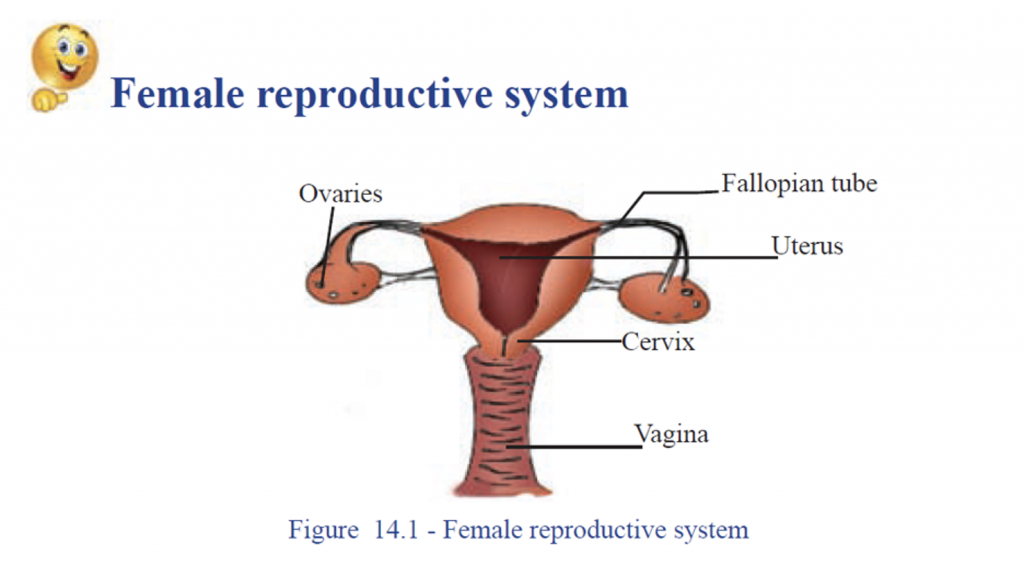
The female internal reproductive system is equated to the entire female reproductive system in the grade 7 Health and Physical Education textbook.
It is obvious that our conversations about female pleasure are hampered by this lack of terminology. How can one even start a conversation when they have no idea what they are talking about? Because language is what gives something’s existence validity. When there is no language, it is almost as if the thing itself does not exist.
What can we do about this?
There are many things we can do, such as lobbying for curriculum revisions, but throughout this article, I am only focusing on things we can do on our own, as part of our online lives. The first step is to popularize proper genital terminology in local languages, with a special emphasis on the parts that make sex a pleasurable experience for women. We all can start by sharing educational content created by others that discusses sex organs without shame or stigma and try to normalize these things appearing in our social media feeds. We can also create our own content and conduct targeted campaigns with hashtags such as #KnowYourBody. Planned Parenthood provides great source material, so do countless other websites and social media sex educators.
Pleasure is the last thing we mention when we talk about sex.
Sri Lanka’s semblance of sex education focuses heavily on reproduction and the prevention of unwanted pregnancies, sexually transmitted infections, and sexual violence. Abstinence is encouraged, and the “consequences of irresponsible sexual behavior” are emphasized. The only mention of “pleasure” in grade 9 Health and Physical Education textbook is this: “Immense pleasure can be gained by making various kinds of cooking utensils from the material available in the environment…”. Well, I can certainly think of a few other immensely pleasurable activities that we should probably discuss with adolescents.
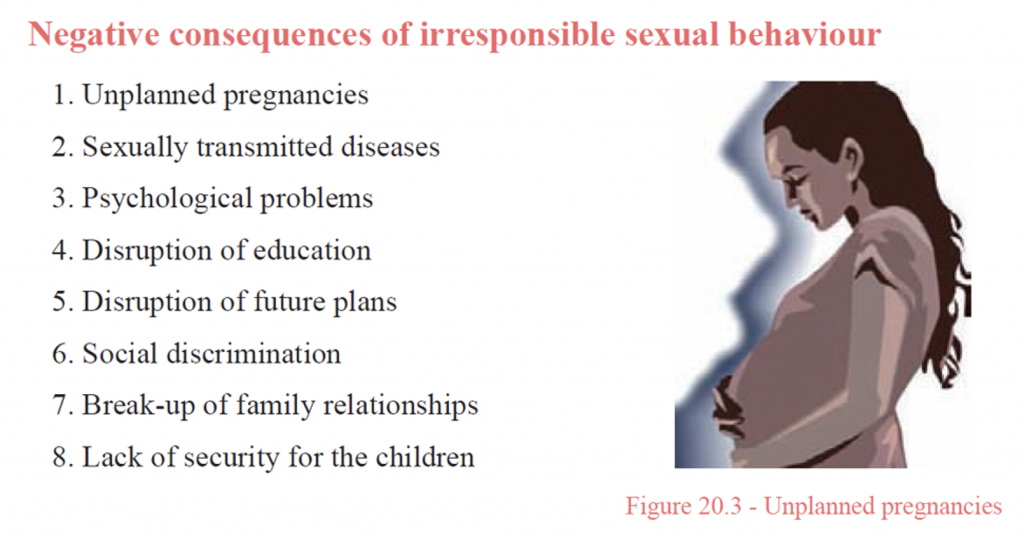
The Grade 9 Health and Physical Education textbook emphasizes the consequences of irresponsible sexual behavior but makes no mention of sexual pleasure.
While an overemphasis on risk prevention has a negative impact on every child’s perception of sex, it is more prevalent in girls, who are more cautioned due to their ability to get pregnant. They begin to perceive sex as something dangerous that happens to them, rather than something they actively, consensually engage in. This conditioning makes it difficult for them to anticipate, seek, and ask for pleasure, even in long-term relationships. Boys, on the other hand, grow up believing that sex is something they do to or take from women, and as adults they find it difficult to focus on their partners’ pleasure. According to studies, women who have sex with women have more pleasurable sex than women who have sex with men.
What can we do about this?
Again, the best thing to do is to simply start talking about pleasure, including masturbation. Masturbation has been a contentious issue in Sri Lanka, with opponents of “Hathe Ape Potha,” a recent attempt to incorporate comprehensive sexuality education into the school curriculum, citing the reference to masturbation as a key point of contention. If discussing masturbation on social media out of the blue does not sound appealing, we can tie the discussion to some of the recognized dates for it. For example, August 8th is International Female Orgasm Day, while May is Masturbation Month and May 28th is International Masturbation Day! While these are not United Nations Special Days or anything, they do provide a useful hook for us to begin a discussion about them. When it comes to normalizing taboo topics, humor goes a long way, and many sex educators use memes and other humorous content to get their message across.
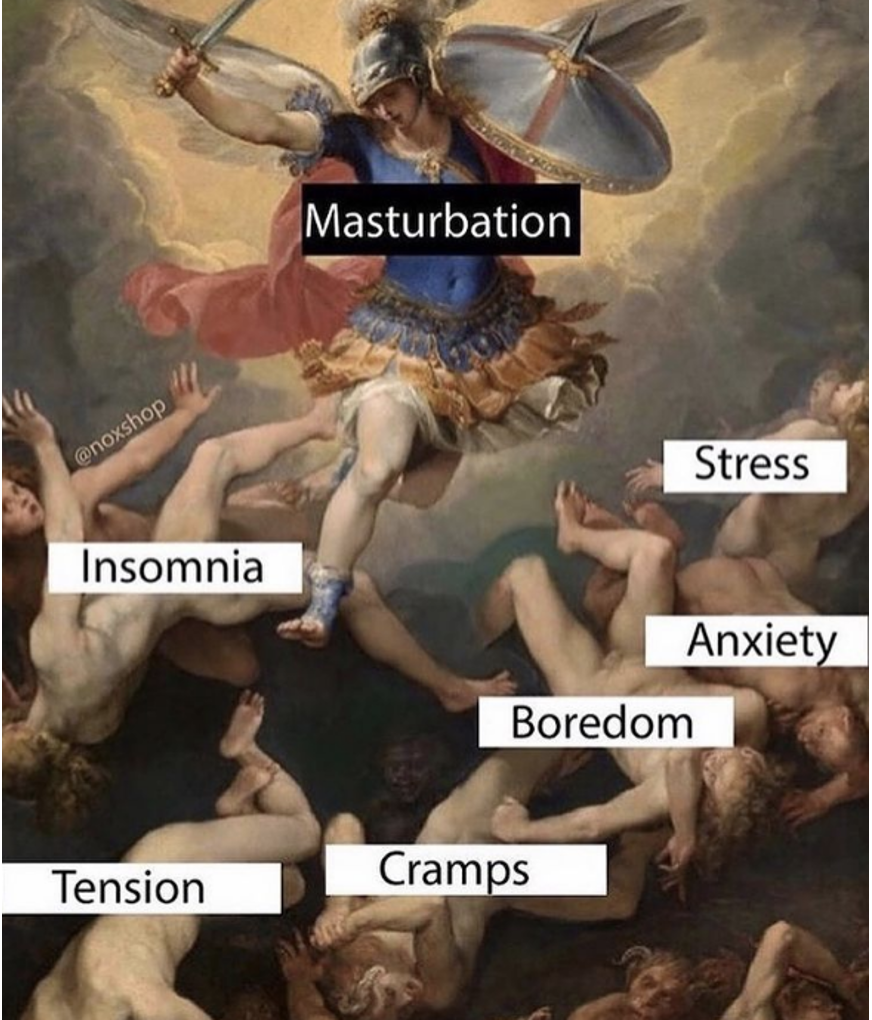
A meme depicting the numerous benefits of masturbation.
Open dialogue is frowned upon.
In Sri Lanka, there is a strong stigma attached to open discussion of female sexuality. Although younger generations are increasingly open about female pleasure, there is still a strong opposition to it. This was abundantly clear during a recent discussion about virginity. According to social media, a certain young woman had spoken out about how virginity is a social construct, enraging the masses, who proceeded to make countless memes about how sexually promiscuous she must be, a woman who has already lost all her “virtue.” This is not an isolated incident. Women who have stated that they enjoy sex, or who have had multiple partners, or simply women who have moved on after a breakup or the death of a partner have all received similar social media backlash.
What can we do about this?
Individual social media users may find it difficult to respond to a flood of content like this, but it is critical to try. Responding with counter-memes is an excellent way to do so, as is reaching out to specific people on our social media accounts if we notice that they are sharing similar content that disparages women who express their sexuality. However, we must choose our battles wisely and plan our counter-narratives accordingly. Hashtag Generation’s handy counterspeech toolkit provides helpful guidelines in this regard. It is available on their website in all three languages. Hateful content can be reported to respective platforms for violating community standards, while group admins could play an important role in screening content that is posted on their platforms.
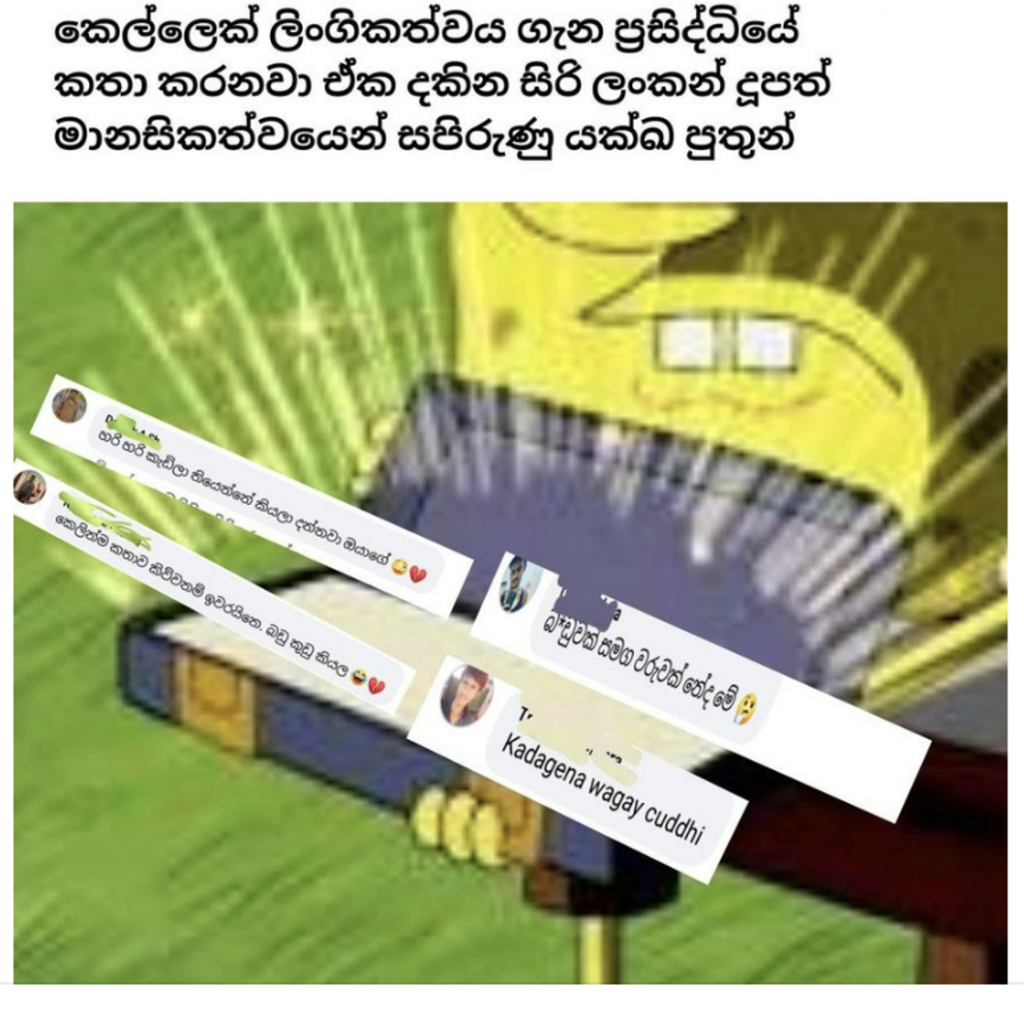
A meme that attempts to counteract the hateful comments directed at the woman who spoke about the concept of virginity.
Online derogatory language and objectification of women.
This is related to what was said above, but the difference is that women, or even girls, who are subjected to such language and treatment may be people who have never spoken about sex. Women who have displeased the masses in some way are sometimes slut shamed online, even if the behavior that drew the masses’ ire in the first place is not sexual in any way. A 2020 US study discovered that the words ‘slut’ and ‘whore’ were used 419,000 times in misogynistic tweets in a single week. I could not find any statistics for Sri Lanka, but the use of local language equivalents is common, especially in comments. Such usage reinforces the idea that she who enjoys herself and exercises her sexual agency should be shunned and shamed.
The other branch is the objectification of women and girls through various online platforms where their images or videos are shared without their consent. On Facebook, there are groups dedicated to displaying such photos, with a caption inviting people to comment on what they want to do to them. The content ranges from non-consensual sharing of intimate videos, commonly referred to as ‘revenge porn’ to pictures of random girls in school uniform, secretly taken in a bus or another public setting. Our society struggles so much to accommodate female sexuality that it almost appears to be telling women not to have sex at all, or even not exist at all. This is clear when you consider the speed with which revenge porn spreads online, as well as the reactions to the victim, with the general idea being, “what else was she expecting behaving like that?”
What can we do about this?
One of the first things we can do is to publicly condemn these acts and state on social media that we support the victim. We can report derogatory language to the platform. We can report non-consensual photo and video sharing too to the platform, but we can also involve law enforcement and special cyber security units. We need to know which helplines to call to do so easily. To build that capacity, we can share that information in advance on our social media accounts. Hithawathi and Bakamoono, among other sites, have useful resources that can be shared right away or used as a source for your own content development initiatives. By doing so, we can both help women feel safe when exercising their sexual agency and counter practices that objectify and demean women, which poses a significant barrier to the acceptance of women as sexual beings with their own desires and preferences.
Long journey ahead
One might wonder why it is important to discuss female pleasure; the answer is simple: the more something is discussed, the less taboo and unknown it becomes, making it more accessible. It is crucial for girls and women to hear other women discussing female pleasure comfortably and casually. Knowing and owning female pleasure and sexuality can be very empowering, both for women and society as a whole, because it increases general happiness and confidence, deepens our relationships, and improves our sense of self-worth. Women must be able to explore their desires and embrace the complexities of sexual pleasure in a welcoming, empowering, and indulgent environment. Bringing about this change, however, is not an easy task, but it is also not an impossible one. Every post about female pleasure that we share on social media goes a long way.
(The author is an attorney-at-law and a sexual and reproductive health and rights activist.)