
Image Credit: Daily Tribune
By Tasneem Shakir Hussain
“GO KILL YOURSELF!”
The above is an actual response that was made to a speaker addressing the topic of HIV online. This, and more. These responses may have been online, but not limited to mere words. There has been hate speech, public shaming, vicious unaccounted rumors, alienation, and even hate crimes and death threats against those who have strived to shed light on this crucial yet heavily stigmatized topic of HIV.
What is Stigma?
Stigma is derived from a Greek word meaning a mark or stain, and it refers to beliefs and/or attitudes. Stigma is an attribute, behavior, or reputation which is socially discrediting in a particular way. This mentally classifies someone in an undesirable, rejected stereotype rather than in an accepted, normal one. Stigma can be further subdivided into perceived stigma (felt stigma) and enacted stigma (external stigma, discrimination).
Shame and expectation of discrimination that prevents people from talking about their experiences and stops them from seeking help are referred to as perceived stigma. The experience of unfair treatment by others is referred to as enacted stigma. Perceived stigma can be as harmful as enacted stigma as it leads to withdrawal and restriction of social support.
Let’s explore the prevalent stigma around HIV in Sri Lanka, especially online, and the information gaps that aid these unfavorable attitudes.
This article is based on discussions with individuals who openly speak about HIV on various platforms and online to share their knowledge and information and create awareness and the stigma they have faced firsthand.
Why is there still stigma despite the widespread utilization of the internet and mass media in the awareness and prevention of HIV? What makes people act out, disassociate or even show hate towards Persons Living with HIV (PLHIV)?
It’s a simple answer – it is a lack of information.
HIV prevalence in Sri Lanka is relatively low- the estimated number of people living with HIV (PLHIV) recorded in the 3rd quarter of 2020 is 3,920. However, accurate assessment of HIV prevalence is difficult to gauge as social stigma, and lack of knowledge make HIV prevention and information campaigns difficult. UNAIDS estimates the total number of infections is at least three times higher than indicated by official figures.
Information on experiences of stigma and discrimination is primarily anecdotal and fragmented. Interaction and discussion with Positive Networks suggest undocumented stigmatizing attitudes and behavior among family, colleagues, friends, healthcare sector, employers, and even religious leaders.
Often information on stigma and discrimination has to be 1 UNGASS Country Progress Report Sri Lanka 2010, p.4 2 Ibid, p.15 extrapolated from research on HIV Knowledge, Attitudes and Behaviour studies. For example, in an HIV & AIDS Rapid Situation Assessment (RSA) of the Maritime Sector in Sri Lanka, conducted in January 2010, students from across three maritime schools in the country (Colombo, Panadura, Galle) showed that knowledge of HIV transmission and transmission myths does not necessarily reduce stigmatizing attitudes towards people living with HIV. Over 90% of students identified the modes of transmission correctly. Over 80% identified existing myths of transmission precisely (including use of the same toilet facilities, speaking with and touching people living with HIV, and being sneezed on by people living with HIV), but when asked if they would work alongside people living with HIV (49%), share tools and equipment (37%) or share a room (35%) these numbers dropped dramatically. So, although there is enough information readily available online, it is not just the accessibility but also a lack of interest and understanding that adds to this stigma.
Over the years, some people have come forward to share their experiences to create awareness on HIV and knowledge sharing. They have publicly revealed their HIV statuses to make others comfortable to go to them for information and start an open discussion about this almost taboo and often misconstrued topic.
They have successfully reached out to people via their social pages and spread valuable facts and information, including contacts and websites that individuals can reach out for testing, support, and treatment. They have also garnered lots of positive feedback from their audiences, who appreciate their work and bravery for sharing their experiences, despite the stigma.
One such individual is Sriyal Nilanka, living with a positive HIV status for 8+ years. His work in collaboration with the Family Planning Association of Sri Lanka, the Australian Federation of Aids Organisations, and more such institutions has been significant and recognized. He was also the recent recipient of the HIV Hero Award at the APCOM Awards 2020 for awareness generation and fighting stigma and discrimination towards Persons Living with HIV in Sri Lanka.
Sriyal shares his views – “information and attitude are what matter when it comes to fighting HIV stigma”. He believes this stigma stems from fear of deviant behavior. He has received commendation for his efforts, and he recognizes and that most often the negative comments are from those who have not understood the context or those who have preconceived notions of how culture and society should be in their minds.
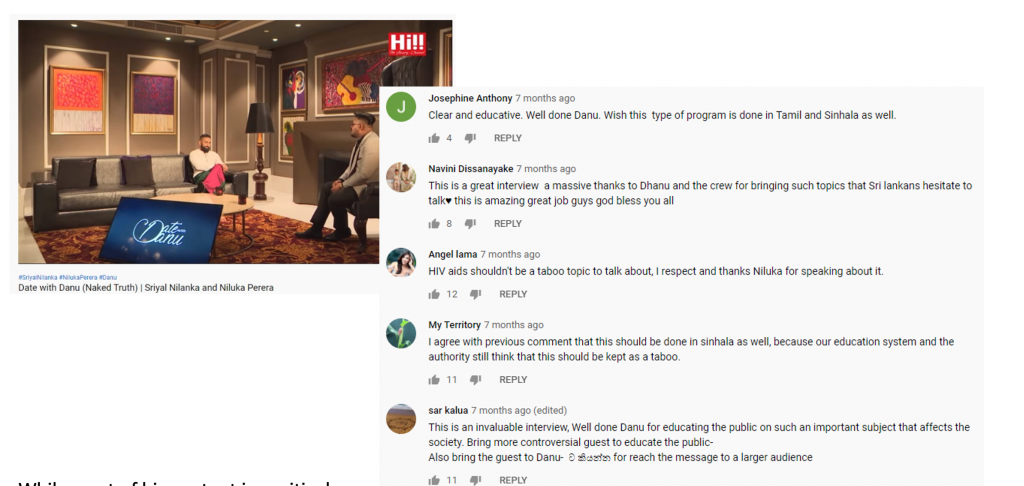
While most of his content is positively received, it is noteworthy that there has been an increase in acceptance for such content in the recent past. There have also been some eye-opening comments that have highlighted the inaccessibility of information for the masses.
One significant gap is that most of the information available online on the subject is in English and includes medical terminology that can be intimidating for those living in a country where the national languages are Sinhala and Tamil. The unavailability of this information in local and straightforward languages also widens the information gap and may translate to stigma stemming from ignorance.
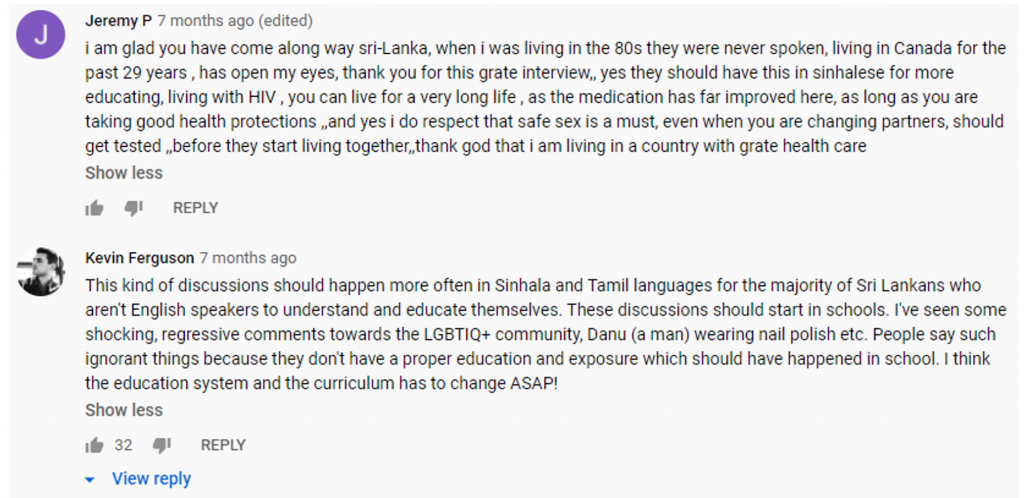 Periodically, there are the odd comments that are mostly ignored; however, these give an insight into what some (albeit a small number of people) think. These comments show how people receive information and form judgments regarding gender, religion, and culture.
In Sri Lanka, it is still regarded as shameful for women to express their sexual status openly. In comparison, most comments portray how religion and culture have shaped their thoughts.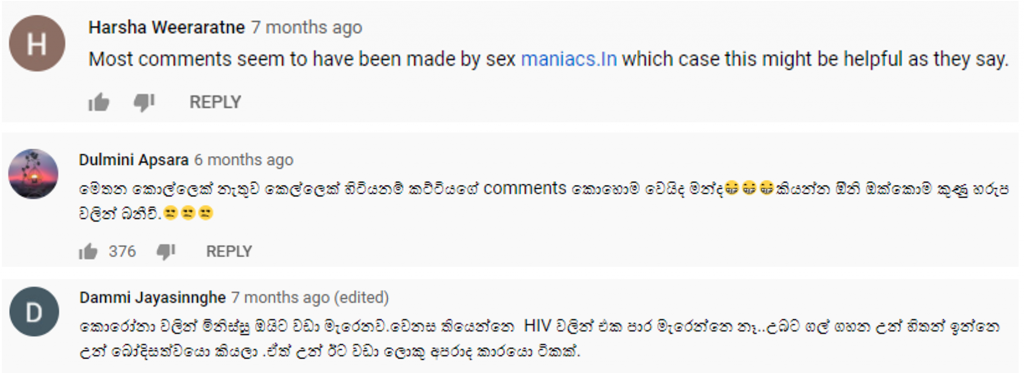
Some want to hear the facts from a figure of authority and discredit the information shared. These comments can be damaging, too, as they harm the professional personalities of these individuals.
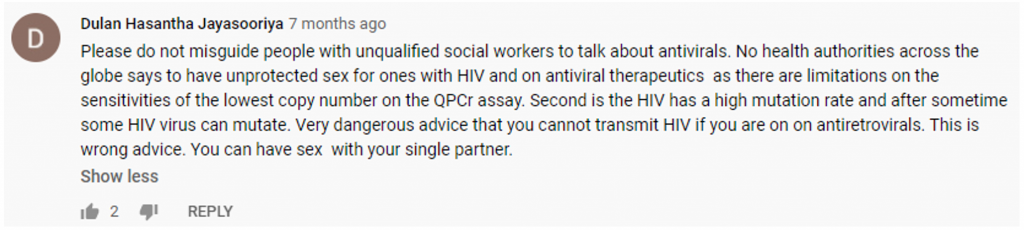
What is more alarming are the responses received on private profiles, even on platforms such as Grindr, the world’s largest social networking app for gay, bi, trans, and queer people.
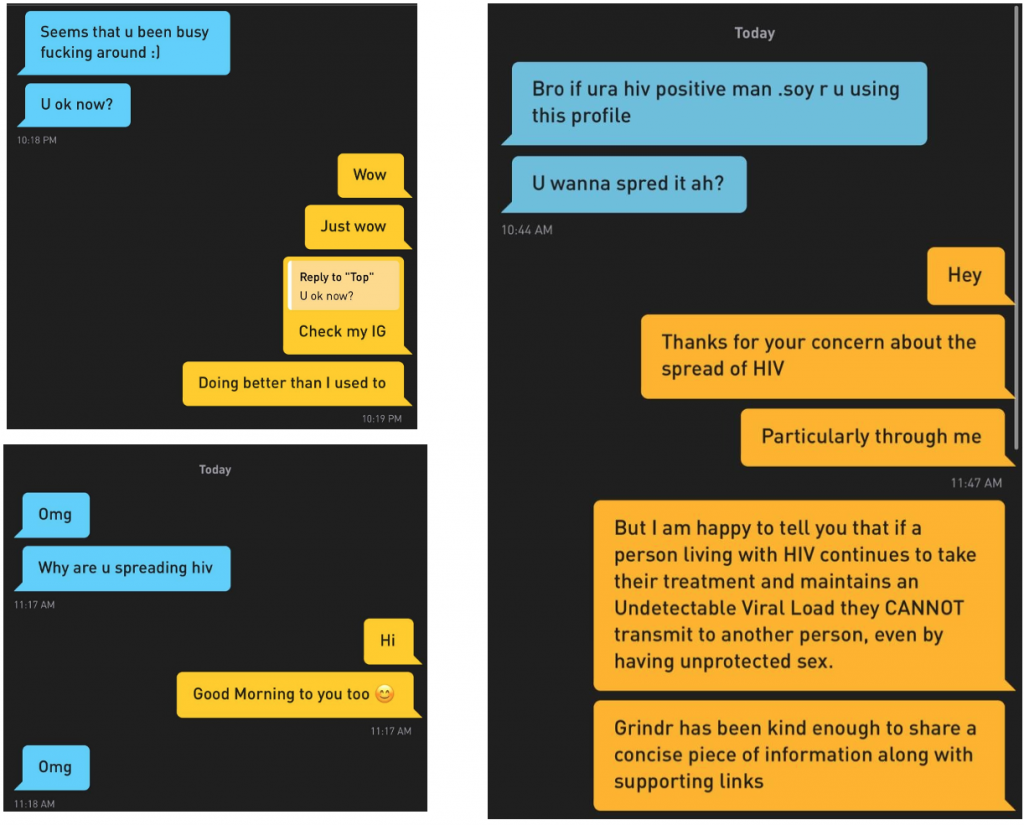
Similarly, another individual living with HIV for 15+ years, Palitha Vijaya Bandara, has also invested his efforts into making a difference in this field. He is the Project Coordinator at Positive Hopes Alliance, a community-based organization that works with and for people living with HIV, established in 2009.
Palitha has been a part of various HIV campaigns and hosted workshops, and worked alongside the Youth, Women’s Organisations and the forces (prison area) and the Divisional Secretariat on World Aids Day programs and more.
Although these campaigns have been received well, over the past two years efforts, have been dedicated to sharing knowledge online, via Facebook and other Social Media platforms. This is because of the shift from a larger screen to the phone and because there was apathy in simply learning the experience of a Person Living with HIV and closing the substantial gap of knowledge.
Palitha also pointed how Sri Lanka as a country hasn’t progressed in its thinking process. “We have an islander’s mindset, and we are isolated from the ideologies of the world. This warped with culture handed down generations does not allow the people to accept diversity and adapt change”.
It is humorous to note that some are willing to take the Covid19 vaccine, which has been tested only for a couple of months but refuse to believe over a decade worth of research and testing that proves undetected HIV is untransmittable.
For the past 20 years, evidence has been building to show that the likelihood of passing on HIV is linked to the amount of the virus in the blood. A Person living with HIV on effective treatment (to reduce the amount of the virus to ‘undetectable’ levels, also known as having an undetectable viral load) cannot transmit HIV. Hence, this is what is meant by the phrase Undetectable equals Untransmittable (U=U).
The landmark PARTNER study, published in 2016, looked at 58,000 instances of sex without a condom where one partner was HIV positive, and one was HIV negative.
In 2018 mother to child transmission was eliminated in Sri Lanka. The World Health Organization’s Regional Office for South-East Asia certified Sri Lanka and congratulated the public health sector for eliminating mother-to-child transmission of HIV and Syphilis’- a remarkable public health success. As a result, some mothers are now living with HIV and having HIV-negative children.
It is important to remember that early detection of HIV is crucial during pregnancy. Transmission is only possible if the person in question has not been tested and unaware of their status and therefore not on treatment.
In discussion with other HIV-positive individuals, they admitted that all their doctor told them was to be careful and use condoms when indulging in sexual activities. In an ideal situation where free testing, support, and medical treatment is available for HIV and where we could be improving public health services, there is discrimination, guarding of information, and institutional stigma that forces more people to go into hiding than seek help.
We can identify that stigma and discrimination towards HIV is mainly due to fear and myths related to HIV:
- HIV is always associated with AIDS, then leading to death. The majority have no idea that it is a chronic condition.
- HIV is associated with behaviors that some people disapprove of (such as homosexuality, drug use, sex work, or infidelity).
- HIV is transmitted through sex, which is a taboo subject in some cultures.
- Some people wrongly believe that HIV infection results from personal irresponsibility or moral fault (such as infidelity) that deserves to be punished.
- Inaccurate information about how HIV is transmitted, which creates irrational behavior and misperceptions of personal risk
What is the solution?
Acceptance and Respect.
There has to be a widespread acceptance of diverse people, lifestyles, choices, and consequences. It is every individual’s responsibility to educate oneself about these topics, understand it for what it is and be open to learning new things.
There needs to be respected. Respect for any person’s choice. Respect their rights. Respect their lifestyle.
The younger generation is more exposed to the world online and therefore open to discussing these topics. We must ensure they receive accurate information in a manner that is understandable and easy to absorb.
Health workers, especially doctors, must advocate for and update the masses about the new developments and discoveries concerning the treatment of HIV. Transparency of information is vital.
It is a long journey, and Sri Lanka has adopted the target of “End New HIV Infections by 2030” and has taken on the challenge of achieving this target five years before the rest of the world, by 2025. Sri Lanka will be required to mount an accelerated response over the next five years to hit its goal of no new HIV infections.
About the Writer
Tasneem Shakir Hussain is an English Copywriter with over six years of experience in advertising and marketing. Apart from advertising agencies, she has also worked on numerous branding projects, websites, videos, and blogs. She had the opportunity to explore the topic of infectious diseases and write an article on the basics of HIV. This was an eye-opener for Tasneem, as she realized how lack of knowledge was the reason for such stigma. She has also had the opportunity to work with Helvetas to create informational video content addressing Human Trafficking in Sri Lanka. Tasneem is keen to share her skills and help spread knowledge and information to mitigate this ignorance.