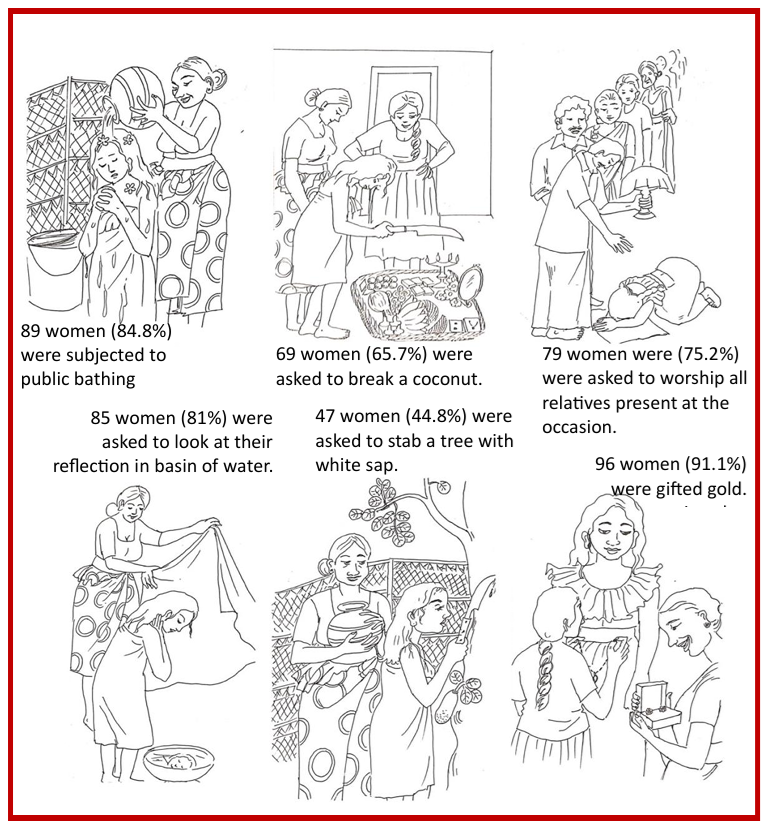
Cultural rituals have long been part of women and girls having their first period. In pre-patriachal societies and communities menstrual blood was perceived as sacred and divine. Menstrual blood was a symbol of the life force that mirrored the natural cycle of nature. Subsequently, these ideas evolved, and with them the rituals that were associated with how we celebrate girls who become women. Below is a pictorial depiction of some customs currently prevalent in Sri Lanka based on the findings of a Grassrooted community research report – ‘Dark Rooms & Evil Spirits: Prevailing Menstrual Myths in 2023,’ which looked at menstrual practices in the Ibbagamuwa Division of the Kurunegala District with 107 respondents.
The patriarchal narratives that built around menstruation can also be harmful, especially those that are steeped in mysogyny.
Menstruation makes women prone to demon possession, which makes them “emotionally unstable.”
In Deborah Winslow’s 1980 paper, Rituals of First Menstruation in Sri Lanka, which appears in the National Healths: Gender, Sexuality and Health in a Cross-Cultural Context (2005) the discussion with community representatives reveals that the presence of blood is what gives the demon its window to possess the girl/woman.
In 2026, while we may presume these archaic beliefs absent, with information more readily available on the function of menstruation, demon possession remains to be a development that is allowed for, even accepted. In ‘Dark Rooms & Evil Spirits: Prevailing Menstrual Myths in 2023,’ a grassrooted community research report on menstrual practices in the Ibbagamuwa Division of the Kurunegala District with 107 respondents, demon possession was a common motif.
“A key reason for the seclusion of girls who have had their first period appears to be an effort to protect them against evil spirits. Menarche apparently makes girls more vulnerable to evil during the proscribed period. 81/107 were given a sickle to place under their bed, while 64/107 were given a nail tied to a blessed white thread. Both these are indicative of a prevalent myth that perceives iron as protection from evil spirits.”
Food restrictions, a common practice during a girl’s first period, are similarly linked to the presence and attraction of evil spirits, with any form of meat and fried food items being strictly prohibited as these food items are “believed to attract evil spirits upon her.”
Unclean, Unclean, Unclean
Teachers, parents, adults and young people in Sri Lanka, regardless of an urban, provincial or rural locus and religious beliefs, generally have a perception that menstrual blood is somehow unclean. When asked if menstrual blood differs from blood from a cut finger, menstrual blood is commonly identified as dirty versus clean blood from the cut finger. Menstrual blood is considered waste matter that the body rejects, and has been likened to pus from an infected wound.
The Judeo-Christian and Islamic traditions have very specific scriptural instruction on the taboos around menstruation that find their roots in Biblical laws as laid out in the book of Leviticus, which have had a lasting influence on Christianity and Islam.
“19 Whenever a woman has her menstrual period, she will be ceremonially unclean for seven days. Anyone who touches her during that time will be unclean until evening. 20 Anything on which the woman lies or sits during the time of her period will be unclean. 21 If any of you touch her bed, you must wash your clothes and bathe yourself in water, and you will remain unclean until evening. 22 If you touch any object she has sat on, you must wash your clothes and bathe yourself in water, and you will remain unclean until evening. 23 This includes her bed or any other object she has sat on; you will be unclean until evening if you touch it. 24 If a man has sexual intercourse with her and her blood touches him, her menstrual impurity will be transmitted to him. He will remain unclean for seven days, and any bed on which he lies will be unclean.” – Leviticus 15
It is not diffiuclt to understand why religious ritual and regulation around menstruation have often been discussed as patriarchal and/or cultural constructs, that are used to further subjugate and control women. The authors of The Curse: A Cultural History of Menstruation (1988) discuss how religious taboos with regard to sex and menstruation, in particular, may offer insight into the male psyche.
“[The] primary reason for the dread of intercourse during menstruation appears to be the blood itself, which has associations in the male mind with pain, death, battle, injury and castration. It has been found that in those cultures where the intercourse taboo is most strictly enforced, there is a significant degree of castration anxiety (fear of losing the penis) among the males. But official explanations for the intercourse taboo range from the holy to the hygenic, and they do not acknowledge that the male is afraid of anything. For example, in certain patriarchal cultures, the dread that the male feels toward the menstruating woman becomes part of his worhsip of his gods. In some societies, violations of sexual taboos are seen as sins against god; in ancient Persia, the offence was so serious that it warrented burning in hell until Judgement Day.” – The Curse: A Cultural History of Menstruation (1988)
In Sri Lanka menstruating girls and women are dissuaded from attending Buddhist and Hindu temples during their period. Women and girls, regardless on whether their menstruating or not are also disallowed from visiting the holiest spaces of Buddhism – the Paththirippuwa [Octoganal Pavilion] of the temple of the tooth in Kandy, where it is believed that Buddha’s tooth relic resides, and the upper portions of the Bodhi Tree in Anuradhapura. These restrictions apply despite the fact that both the sacred relic of the tooth and the Bodhi Tree were believed to be brought to Sri Lanka by women.
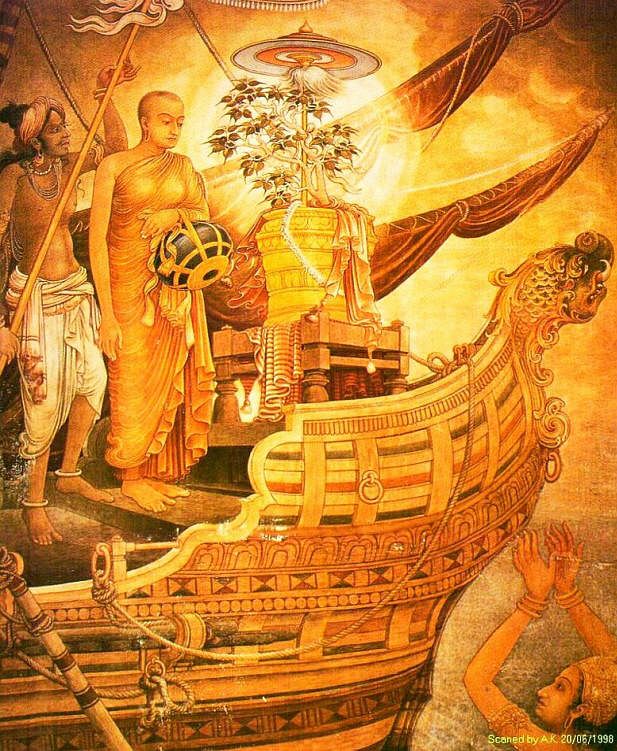
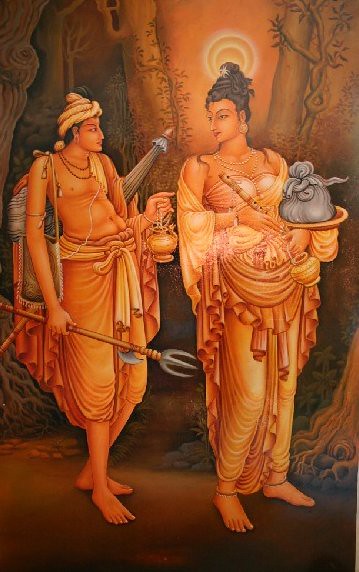
The incident occurred in the 4th century CE . The king was Guhaseeva whose kingdom was Kalinga (present Orissa). The precious item was the Sri Dalada – the Sacred Tooth Relic, the left canine tooth of the Buddha. The pair was bound for Sri Lanka where the king was ruling from Anuradhapura, the nation’s first capital. It was the ninth year of reign of the king, Kithsiri Mevan who had ascended the throne in 303 CE.”
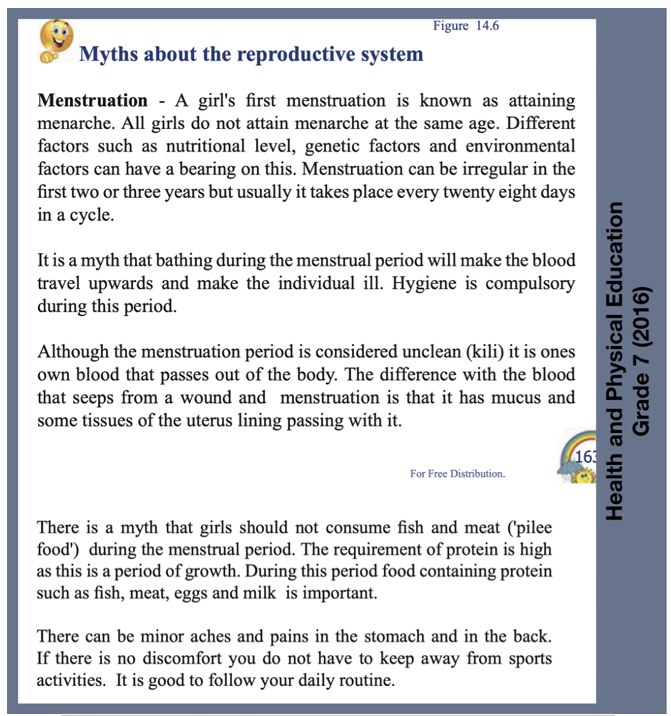
These myths around women being unclean prevail despite them being debunked in the Health and Physical Education textbook, thereby underpinning the ongoing challenge of disseminating accurate and comprehensive information around menstruation.
Reinforcing the Gender Binary
In Sri Lanka the differences between the men and women, boys and girls, is a dominant narrative. The menstrual cycle furthers this narrative of difference, underpinning it with the sinister warning that girls who are in the process of becoming women should now beware of men.
“The first period is an opportunity to reinforce the gender binary. Not only is the girl different from the boy, she is now also in danger from the boy, and man 88/105. She should not even speak with him 63/105. No specific reasons were offered. The conflation of the hymen with the social construct of virginity is apparent in the edict to avoid the bicycle 68/105, and the concern over her virginity is also reflected in the detailed instructions on sensible dress 70/105, and sensible curfews of 6pm 88/105 – once more linked to those unnamable fears related to men and boys.
The fear that we inculcate in our girls is often mirrored in the sense of entitlement we inculcate in our boys. Boys are portrayed as hyper-sexual with no self-control. This notion is often, conveniently, with no scientific basis, perceived as a natural state for the homosapiens male. It also lends to an asking-for-it culture, where girls who wear dresses above the knee and stay out later than 6pm should expect sexual violence. What of the girl with the loose hair? This appears to be the most frowned upon indiscretion among those listed 96/105, again sexualizing and commodifying the girl.” – Dark Rooms & Evil Spirits: Prevailing Menstrual Myths in 2023