
31/08/2026
Dileesha Amarasena
What is happening across some Facebook, Telegram and WhatsApp groups in Sri Lanka is deeply disturbing. And perhaps one of the most sickening parts is seeing people in the comments asking and even selling nudes of their own mothers, daughters, sisters and other women sexualizing their bodies as if this is something normal, funny or acceptable thing.
As Sri Lankans, we often pride ourselves on being a cultured society. Whenever something happens to a woman or a child, one of the first things people say is, “Imagine if this happened to your own mother, your sister, or your daughter.”
And then I look at some of these comments and think what happened to that sense of humanity?
Because here we are, seeing people sexualizing and objectifying their own mothers, sisters and daughters. The same people we are supposedly asking others to think about before harming a woman. This exposes the hypocrisy in the way we often talk about protecting women and children in Sri Lanka. Women shouldn’t have to be someone’s mother, sister or daughter to deserve dignity. They should be respected simply because they are human beings.

And Some comments have even talked about children.
Imagine seeing someone casually say that their sister is only five years old and sexualize her. How sick does a society have to become for a five-year-old child to be treated as sexual content? Itis not a category in some porn site.
This is not humor.
This is not “boys being boys.”
This is not harmless online behavior.
This is deeply disturbing
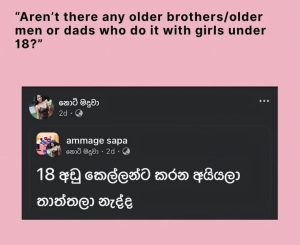
And we also the wider misogyny and toxic online cultures that allow this behavior to grow.
There are spaces within the wider manosphere where women are constantly objectified, degraded and treated as though their bodies are something men are entitled to. When these attitudes are repeated often enough, they can become normalized and it’s slowly become entertainment.
Have you ever thought about what it feels like to simply be a woman in public?
To use a public toilet and wonder whether someone could be recording you?
To adjust your clothes in a changing room and wonder whether there is a hidden camera?
To get on public transport and wonder who might be taking photographs of you without your knowledge?
To post an ordinary photograph online and later discover that someone has downloaded it, manipulated it and shared it somewhere you never knew existed?
The fear is always there.
And also, these groups did not suddenly appear this week. Many of these online spaces and networks appear to have existed for years. Yet very few people were talking about them. So, when someone says, “Oh, you only found out about this now? This is old news,” If something has existed for years, that makes the silence around it more disturbing but not less. But as a society what we can do is not giving these groups a more reach by avoiding unnecessarily sharing their screenshots, links or harmful content. Even if our intention is to make them accountable avoid aggressive commenting, sharing and interacting can create engagement that may help the algorithms recommend or push that content to more people.
Instead, report it. We can report the accounts and groups through trusted partners, verified reporting channels or the relevant authorities who can actually take action.
Support the people whose photographs or videos have been taken, manipulated, sexualized or shared without their consent. We never know, it can be an AI generated, Deepfake or real person behind it.
The fact that people finally started talking about it matters. Because once people started raising their voices, authorities began responding.
The Ministry of Women and Child Affairs has said that information regarding the alleged activities was received and that preliminary findings were referred to the Sri Lanka Police Bureau for the Prevention of Abuse of Children and Women and the Computer Crime Investigation Division for further investigation.
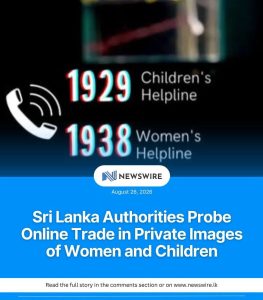
Sri Lanka Police have also announced steps to identify and deactivate Facebook groups involved in distributing obscene material involving women and children, and a dedicated email channel has been introduced for reporting.

Sri Lanka CERT has also been involved in addressing online safety and cyber incidents, with an official mechanism for reporting social-media-related incidents.
This is exactly why speaking about these issues matters. Because silence does not protect victims. Silence protects the people who benefit from nobody asking questions. And this is also why conversations about the gaps in our legal system matter.
A lawyer and content creator Chethana Ketagoda has pointed out, openly discussing these cases and gaps can help expose where existing laws and legal protections may fall short, they can be reformed. But we cannot reform laws around problems we refuse to acknowledge.
We don’t even have to agree on every aspect of how this issue should be addressed. It’s about dignity, empathy, and accountability and what kind of society are we willing to accept?
And most importantly, don’t dismiss the conversation simply because the problem existed before you heard about it. Sometimes, starting the conversation is exactly how we start changing the system.