
By Hans Billimoria
Mystery
The only time I remember my mother hitting me as a child was when I destroyed her packet of sanitary napkins. I would’ve been around eight, and I recall being fascinated by the adhesive strip that ran the length of the cellucotton pad. I had in the past sparingly used these adhesive strips to mimic sellotape to stick on my bedroom wall the odd faded glossy magazine page of a 60s sports car or a Nile crocodile from a dusty pile of National Geographics consigned to the waste pile awaiting the bottle and paper man. Never had there been such a reprisal. I imagine when my mother discovered that the odd pad was without adhesive strip to hold it in place on her cotton panties – “that bloody child!” would’ve been the immediate sentiment, soon forgotten. But that fateful day of the many slaps I had clearly stepped over the proverbial line that allowed for maternal love to momentarily flounder in a fog of frustrated, harassed retribution. In fairness to my gentle mother, I destroyed her entire pack of Free & Easy – typified by a dancing snow white ballerina figurine. I didn’t even use the strips for any beneficial purpose. I just enjoyed the sensation of unsticking what was stuck, and left the evidence strewn about the bathroom floor.
I never understood why I was woken up and slapped… or perhaps woke up while being slapped. Her rage was unrecognizable. My crime incognizant. What did I do? What were those pads? Something to do with her, yes, but what? I had no idea that bereft of the adhesive strip the gum dries up on the pad, and allows for it to be more mobile in her panties, compounding an already uncomfortable situation. I didn’t know that the pads were receptacles for menstrual blood. Or did I? Had I overheard an adult conversation? Had I observed a rare botched attempt at disposal? Why was she bleeding? Was she sick? Was she hurt? What was happening to my mother?!?
Of course, I never asked these questions. Futile. I knew the answer would end in a derivative of the BECAUSE clause. “Because that’s the way it is.” “Because it happens like that.” “Because I say so.” “Because!” It was the early 80s. Adults used the BECAUSE clause indiscriminately and often to shut the inquiring mouths of precocious babes… aged eight.
Menopause probably hit soon after because the dancing snow white ballerina and her soft cellucotton pads stopped visiting our bathroom. And pads no longer figured in our lives beyond the occasional TV commercial of bright blue ink being poured into super absorbent cotton, until one day arriving home from school, about six year later, I discovered my nine-year-old sister locked up in a room with Caroline standing guard. Caroline had been with the family forever as a primary caregiver. My parents were out, and when I inquired after my sister’s health, I was gruffly instructed to remove myself from the vicinity of the locked room. My other nine-year-old sister – older twin of the prisoner by a full minute – was also suitably shaken by this strange and mystical occurrence: Caroline had never been gruff with us, ever! What was going on? My mother soon returned and thankfully released the prisoner, and for the first time that day, I learnt from her that girls bleed every month from their vagina. I was fourteen and while I knew the rudiments of penises and vaginas and what goes where and that done right babies may ensue – this horror story was new. There was also other paranormal activity alluded to in discussions that you strained to hear; they concerned mutant chickens. Apparently, it was eating chickens that had made her bleed so early at age nine. Would I bleed too because of these hormone-addled mutant chickens? And if so, from where? Which designated orifice? My mother must have read the concern on my face and went on to clarify that this was a natural part of growing up for girls, and much to Caroline’s consternation, allowed my sister to interact as usual with the family. Soon after, a familiar package entered our bathroom lives again – Free & Easy sanitary napkins.
Mysticism
My mother’s calming clarification – bleeding was a natural part of growing up for girls – held well into my 30s, until I started working in the field of sexual and reproductive health and rights (SRHR) circa 2010, when my partner Paba conducted a session on menstruation. I remember being fascinated as I listened to her explain in detail the whys and hows of menstruation to a group of young men and women tasked by UNFPA with being SRHR peer educators in Vavuniya and Anuradhapura. Ovaries, fallopian tubes, womb walls, and unfertilized eggs had floated about for years but not until that day, did they logically and sequentially fall into place. This was also the first time I heard the word – endometrium; which sounded like a Roman arena where gladiators battle to snuff out lives.
This may sound inconceivable, but even after spending almost fifteen years in India, working on HIV care and support programmes discussing body fluids ad nauseum, conducting awareness sessions on how HIV positive mothers can successfully have HIV negative babies; being sexually active for almost two decades; surviving the odd pregnancy scare after unprotected sex; buying sanitary products for sisters, friends, girlfriends and wives; pampering partners through their period pains including emergency night runs for pain relief medication; not until that day with the young people from Anuradhapura and Vavuniya did I understand how the menstrual cycle actually functions.
This meant that even my hitherto visceral rejection of indolent menstrual practices based on ancient religious instruction was not based on science, but on my mother’s bare minimum truth that menstruation was part of the natural order and should not be feared. Post 2010 HIV training sessions in the low prevalence setting of Sri Lanka understandably reduced, and SRHR, gender, and violence prevention became our bread and butter as UN consultants. This meant that I had to internalize the science of menstruation. Our approach as non-scientist communicators had always been to demystify issues. Approach them logically. Help people move beyond traditions and practices that stigmatize and discriminate. To do this successfully, the science had to be sound and the myths and misconceptions understood. If we just went in and laughed and made fun of deeply held beliefs, then we would fail. We knew this through experience working in rural and provincial contexts in India and Sri Lanka. We had also learnt sensible approaches from our friends and colleagues in Africa [Malawi and Kenya] on how to counter harmful tribal convictions that allowed for HIV to ravage a continent.
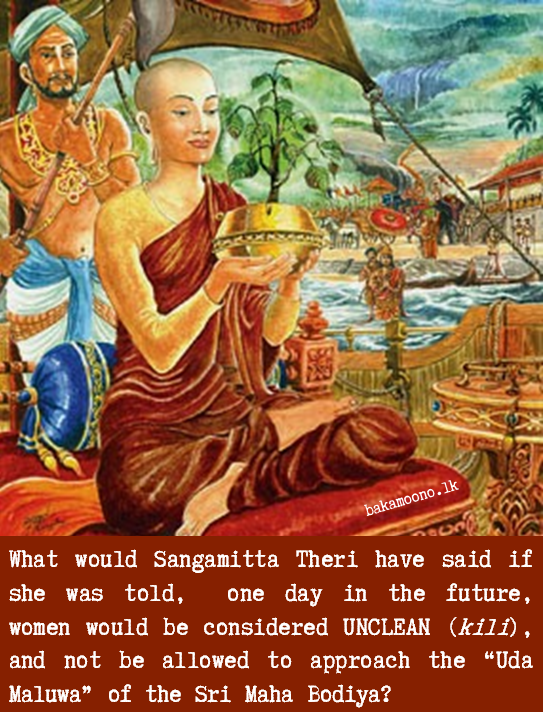
We found that the most effective way to counter stigma and discrimination born of ignorance and fear was to help break the silence regarding menstruation; address the foundation of the myth. We would listen to women and men speak of why they believed menstrual blood was unclean and impure. We would help them separate myths from facts, until we were left with the bare minimum truth – menstrual blood on a cellular level is no different from any other blood. The concept that women were unclean was exactly that, a concept. It was a patriarchal construct that manifest itself in making women feel inferior to men. When asked who bore the sacred Bo tree to Lanka, or who hid the sacred tooth relic upon their person to protect it – the answers were both women; Arahant Saṅghamittā Theri and Princess Hemamala. How then does this reconcile with beliefs in Dehiattakandiya that even the sari of a grandmother [presumably menopausal] should not be used to fashion wicks for coconut oil lamps in the village temple as women are unclean? What ‘clean’ garments are permissible then? Men’s sarongs? Yes, of course. What then of the cautionary fables that young women shouldn’t wear a man’s sarong to bathe in the lake as she may impregnate herself with the male ejaculate that is thought to linger? To challenge the inherent misogyny in all faiths is not to devalue the faith. It is to help move belief into fundamentals of praxis – ahimsa – do no harm. It is to reconcile Dinosaur fossils that have lain for over one hundred million years with a creation story, that thanks to Luke’s Gospel of documenting the genealogy of Christ all the way to Adam, dates the world at approximately six to ten thousand years old.
Egyptian women may have used papyrus leaves to fashion tampons thousands of years before they were thought to have been invented, and we could marvel at this ingenuity or even prescribe to theories that menstrual blood was the life force totem-ized by fertility symbols of outsized vulvas and breasts and the documented worship of the Mother Goddess, but the stigmatizing of menstrual blood and those who bleed is also ancient and ingrained into the collective human psyche. The book of Leviticus [circa 6th century BCE], the foundations of Hebraic, Christian and Islamic laws, dedicates an entire chapter [Leviticus 15] to bodily discharge; detailing cleansing rituals for leaky men [including those who ejaculate] and segregation and isolation of bleeding women and girls.
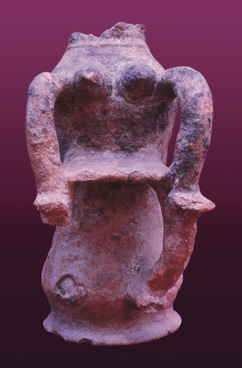
Mother Goddess Terra-cotta figurine from Killinochchi circa 4th century BCE onward
We learnt through pragmatic and brutally honest reflection that collective lifetimes of religious instruction, beliefs, attitudes, behaviour, and practice cannot be challenged by a workshop of hours or even days. As I identified early, “Because I say so.” “Because that’s the way it is.” “Because it happens like that.” “Because!” is a fundamental construct of adult life, and brooks no argument. Add deeply held comforting beliefs that cannot easily divest themselves of other parts of that belief without bringing the source of their comfort into question… well, the construct hardens, solidifies, and grows impervious to logic, even science. Lessons from recent history have underpinned that facts are always capable of being alternative.
Narcosis
In 1994 a landmark conference was held in Cairo, Egypt – International Conference on Population and Development. It was reportedly the largest intergovernmental conference on population and development ever held, with 179 governments participating. The Conference adopted the Programme of Action by consensus, which emphasized the fundamental role of women’s interests. Sri Lanka was there too. And everyone agreed on the transformational potential of education. Education was mentioned over 250 times in the document, repeatedly stressing that without it, progress toward equality and equity was impossible.
“Schools, the media and other social institutions should seek to eliminate stereotypes in all types of communication and educational materials that reinforce existing inequities between males and females and undermine girls’ self-esteem. Countries must recognize that, in addition to expanding education for girls, teachers’ attitudes and practices, school curricula and facilities must also change to reflect a commitment to eliminate all gender bias, while recognizing the specific needs of the girl child.” Article 4.19, Programme of Action, 20th Anniversary Edition (2014)
Education was the panacea in context of sexual and reproductive health too.
“Programmes should involve and train all who are in a position to provide guidance to adolescents concerning responsible sexual and reproductive behaviour, particularly parents and families, and also communities, religious institutions, schools, the mass media and peer groups. Governments and non-governmental organizations should promote programmes directed to the education of parents, with the objective of improving the interaction of parents and children to enable parents to comply better with their educational duties to support the process of maturation of their children, particularly in the areas of sexual behaviour and reproductive health.” Article 7.4, Programme of Action, 20th Anniversary Edition (2014)
Perhaps we didn’t have to wait for a conference in Cairo to tell us that scientific education can dispel myths and misconceptions. Ask Copernicus and Galileo. Still, these conferences are intended to state the obvious, to provide the scientific evidence to transform policy, to set aspirational goals, and this one did. 27 years ago. But have these efforts brought change anymore than running a London Marathon without a Tampon?
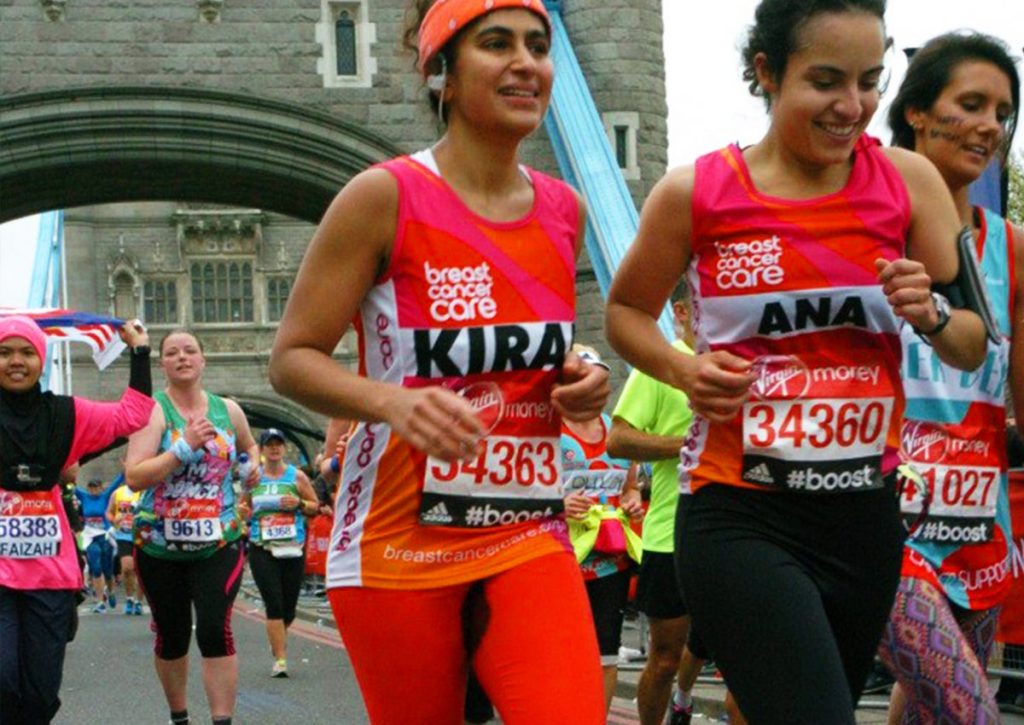
Kiran Gandhi running the London Marathon in 2015
Education being the path to demystifying menstruation is something that the Sri Lankan powers that be have accepted. Currently both Grade 7 and Grade 8 Health & Physical Education text books contain rudimentary information on how the menstrual cycle functions.
The menstrual cycle
The ovaries release ova after a girl attains menarche. This process is known as ovulation. The ovum enters the fallopian tube. The ovum is the maternal cell which takes part in fertilization.
Ovulation is an automatic process. If the ovum is fertilized the uterine walls become thick enabling the fertilized ovum to implant in the uterine wall. If the ovum is not fertilized the uterine lining (endometrium) is shed about 14 days after ovulation. The remnants of the uterine lining and some blood is expelled through the vagina. This process known as menstruation lasts about 2-6 days.
The term menarche is used to describe the onset of menstruation in a female. After attaining menarche the ovaries will release an ovum every 28 days. Ovulation will occur alternatively from the left and right ovaries each month. The release of the ovum, changes in the uterine wall and menstruation which occur every 28 days, if there is no fertilization, is known as the menstrual cycle. In a female ovulation stops by the age of 45-55 years. This is known as menopause. – Grade 8, 2018 Edition
And critically, the Grade 7 Health and Physical Education lesson Let us get ready for adolescence includes a lucid debunking of common menstrual myths in Sri Lanka.
Myths about the reproductive system
Menstruation – A girl’s first menstruation is known as attaining menarche. All girls do not attain menarche at the same age. Different factors such as nutritional level, genetic factors and environmental factors can have a bearing on this. Menstruation can be irregular in the first two or three years but usually it takes place every twenty eight days in a cycle.
It is a myth that bathing during the menstrual period will make the blood travel upwards and make the individual ill. Hygiene is compulsory during this period.
Although the menstruation period is considered unclean (kili) it is ones own blood that passes out of the body. The difference with the blood that seeps from a wound and menstruation is that it has mucus and some tissues of the uterus lining passing with it.
There is a myth that girls should not consume fish and meat (‘pilee food’) during the menstrual period. The requirement of protein is high as this is a period of growth. During this period food containing protein such as fish, meat, eggs and milk is important.
There can be minor aches and pains in the stomach and in the back. If there is no discomfort you do not have to keep away from sports activities. It is good to follow your daily routine. – Grade 7, 2018 Edition
Menstruation gets one more mention in context of personal hygiene where the Grade 7 text states – It is the responsibility of girls to properly dispose used sanitary towels during menstrual period.
In our experience, speaking with young people across the country, despite the inclusion of this information, the classroom is not the space to elaborate.
What is a sanitary towel? How do we properly dispose of them? What other menstrual products are available? Where are they available? Will Tampons affect my hymen? What about menstrual cups? How do I tell my parents not to lock me up like they did my sister when she first got her period? Why doesn’t my father play with me anymore? Why did my parents borrow money from my uncle to throw my sister a lavish ‘big girl’ party? If Kili is just a concept, and blood is blood, why are women and girls not allowed into the holiest of holy Buddhist shrines? Why do Hindu girls take pharmaceutical drugs to delay their periods in order to attend important festivals?
Online resources that encourage rethinking and revaluing of menstrual attitudes and practices:
- The celebrated Menstrupedia that takes into context subcontinent norms and mores
- The Sex Ed platform AMAZE that has accessible scientific content in English
- bakamoono.lk – comprehensive information on menstruation is available in Sinhala and Tamil.
Health and Physical Education appears to be the only subject in Sri Lanka where teachers seem to have the option to pick and choose what sections they impart to their students. They get to officially dismiss the class to the ubiquitous Volley Ball court – no questions asked.The key obstacles to menstruation being discussed within a formal classroom setting is the lack of adequate training to effectively impart the designed syllabus. Any teacher training programme has to necessarily include building a skill set to help teachers overcome the perceived embarrassment and shame associated with menstruation. We have to give them the courage to challenge the myths and misconceptions based on scientific evidence. We have to help them successfully field what they perceive to be awkward and unnecessary questions by boys – in mixed school and boys only school settings; a key factor in the lesson being regularly skipped with the excuse “boys don’t need to know”. Given the marrying of health and physical education, some male PE teachers are tasked with conducting the lesson on menstruation with no training beyond access to the steps in the prescribed teacher guide. To not equip our teachers with the requisite skills to overcome specious cultural norms and mores in the classroom is both a disservice to our students and our educators.
During training programmes for Health & Physical Education teachers we conduct, I always begin with menstruation. It allows for us to unpack early issues of shame, embarrassment and respect that are so tangled and twisted in teaching the science of sex and reproduction. In an anecdote from 2017 that is now tired, but still elicits disbelief, I tell of a female head of the Health & Physical Education faculty of a prominent boys’ school in Sri Lanka. I asked her to describe to me how the menstrual cycle works, my standard preamble to unknotting unclean misconceptions, and this is what she said:
“When an egg is released, a resulting wound from the ovary begins to bleed, and blood flows through the fallopian tube, through the uterus and out of the vagina.”
An incredulous silence followed. One of the two male PE teacher was shaking his heads in disbelief while the other stared stonily ahead wondering if his head of faculty knew something he didn’t. I asked the other teachers if they had a different approach to teaching menstruation, and a younger female teacher appeared relieved to share her version which accurately [and thankfully] involved unscathed egg sacs, unfertilized eggs, with womb walls thickening in preparation and then shedding as per the usual narrative.
This head of faculty with thirteen years of teaching experience, purportedly trained by the National Institute of Education, had obviously never broached the subject in a classroom. If she had, she would’ve read her prescribed text or even had a student challenge her menstrual cycle construct, and so be disabused of notions involving ruptured egg sacs. But what I marveled at was the power of the initial narrative she had been fed as a child, and her continued conviction in her construct. She spoke of it so confidently to a group of her peers, having first accurately depicted the internal female reproductive system on the whiteboard provided. It is what the best alternative facts are made of; an amalgam of science-fact and science-fiction truly and utterly believed.
ICPD’s programme of action speaks repeatedly of involving parents because parental narratives are what children learn to trust first. They are consummate allies in any bid to ensure that young women and men receive accurate and comprehensive information related to menstruation. They have the potential to be the first line of defense against myths and misconceptions. And arguably, the best fora to reach parent stakeholders is schools. If schools involve parents in the collective parenting paradigms they often push in terms of discipline and academic excellence, then it is sensible to extend this to ensuring children are protected from harmful superstitions and humiliating traditions. All school administrators have dealt with irate parents finger-wagging at teachers who fail to complete a syllabus. Imagine a tribe of parents who challenge the health teachers whenever they choose the net-ball court over the menstrual cycle.
Renewal
At the ICPD 25 conference in Nairobi in 2019 the Sri Lankan government, represented by the Ministry of Health, pledged that – Sexual and reproductive health education in schools, and adolescent and youth friendly health services will be further strengthened with the partnership of Ministry of Health, Education, Vocational Training and Youth Affairs.
Just another empty promise on paper, unless policy makers do two critical things:
- In the short term – ensure comprehensive training regimens for Health and Physical Education teachers taking into account the realities around cultural myths and misconceptions that will necessarily pervade the classroom.
- In the long term – involve parents, teachers and young people. Listen to what parents, teachers and young people have to say about communicating menstruation. This takes many conversations. Discussion and debate not one-sided-we-know-better-than-you awareness initiatives. Bring these parents, teachers and young people to the table when discussing education reform with policy makers, then perhaps the perceived political fallout – legislators fearing the loss of votes for promoting sensible education reform related to sexual and reproductive health – will be mitigated. Bring these parents, teachers and young people to the table when sitting down with text book writers, then perhaps claims that our children don’t need to know these things will ring hollow.
ICPD said all this in 27 years ago. We’re just repeating it here in a different form. Much like every outcome document of a conference on SRHR since then. The difference this time is that we’re asking for renewed approaches that appreciate how visceral and real the shame is that we’ve learned to associate with our bodies and bodily functions in Sri Lanka. We cannot escape or deny our current realities around menstruation. Temples and Kovils and churches and mosques and schools and Sri Lankan families play out these realities every single day. Every time a girl is born. Every time a girl first bleeds. Every time she bleeds after that, until the day she stops. And even then, she’s still ritually unclean, and even in her twilight years her saris can’t be used for temple wicks in Dehiattakandiya…
As my mother showed, even the most vague assertions can have a lasting effect on how we treat other people. Imagine then the responsibility parents and teachers have in shaping young minds that run free and easy on the super information highways of the future.