
Image Credit: Borgen Project
By Rashika Fazali
Most of my cousins and aunties from outstation married when they were quite young. Young in this case was 16 and 17 years of age. What was I doing at that age? I was studying and into boys. Marriage was the last thing on my mind. Sadly, in our Muslim culture, this is the norm. It’s the belief that once a girl attends puberty, she magically transforms into a woman – no matter her age, and is now ripe for marriage. The concept of maturity in the physical and mental form is often overlooked. A girl who attends puberty at 12 years old is not physically matured. The transformation from a girl to a woman physically takes a few years. And yet, all of these factors are pushed aside, and the girl child is married off without her having any understanding of marriage, sexuality, bearing children, and life in general.
Let me break it down to you in numbers:
- According to the worldometer website (accessed on 29th Sept 2020), our current population stands at 7.8 billion out of which 21% of women were married before the age of 18.
- 650 million girls and women alive today were married as children.
- Every year, 12 million girls under 18 are married. The math – 23 girls every minute. 1 every second.
- Globally, 1 in 5 girls are married before the age of 18.
- The top country with the highest rate of child marriages is Niger with 76% while the top country in Asia is Bangladesh with 59%.
- According to the Convention on the Rights of the Child report 2019, child marriage accounts to 10% in Sri Lanka. This number varies slightly. According to the Girls Not Brides website, child marriages before 18 years of age accounts to 12% in Sri Lanka.
Good news
- 25 million child marriages were prevented in the last decade.
- Asia had the largest decline in child marriages in the last decade from 49% to 30%.
Though child marriages have reduced drastically globally and over the decade, it doesn’t mean we are better off today. 1 in 4 girls aged 15 to 19 are still unemployed, not in school or in any sort of training. For boys of the same ages, it’s 1 in 10.
Still, we understand those child marriages are not just a girl’s issue. In some countries, young boys are forced to marry before the age of 18, but the ratio between girls and boys is huge. According to the UNICEF report 2014, 156 million men married before the age of 18 in comparison to 720 million women. Almost 7 times higher and worse for girls. How so? Girls under the age of 18 are often married to older men; In Mauritius and Niger, the majority of the girls are married to men who are 10 or more years older than them. Around the world, we know this behavior by a different term: pedophilia. We’ve seen the stories and heard of despicable acts of sexual abuse on children in Sri Lanka lately. It makes our blood boil, doesn’t it? But how are we are okay with child marriages? Think about it: a 12-year-old girl given in marriage to a 30-year-old man. She has no idea about marriage, sex, having children, governing a household, or even life in general. Isn’t this a violation of child rights? Isn’t the 30-year-old man a predator?
The current laws across the globe are quite contradictory. In the Philippines, the legal age of sexual consent was 12 years old before August of 2020 (thanks to a bill, they raised the age to 16 years old). Does this mean that if one can engage in sexual activities at 12 or 16 years old, he/she is old enough for marriage at these ages? But the legal age for marriage in most countries is 18 years old, and UNICEF does define a child as ‘any person under the age of 18’. How does a ‘child’ understand sexual activities and marriage? Shouldn’t the age of sexual consent then align with the legal age of marriage?
153 out of 198 countries (statistics from 2015) have a minimum legal age rule for marriage. But these same countries also have an exception rule to their general marriage law with 117 countries including the United States of America allowing children to marry. According to 2013 statistics, 104 out of 191 countries allow girls under the age of 18 to marry under parental consent, religious and customary law. Using 2013 data, one analysis reported that 23 countries permitted girls under the age of 18 to be legally married without any legal ramifications. These numbers are horrifying, but it may not be as horrifying as the 99 out of 191 countries permitting girls under the age of 18 to marry with parental consent. 30 countries have exceptions for customary and religious laws where there is no legal age for marriage. In Sri Lanka, 2 communities – Kandyan Sinhalese and Sri Lankan Muslims have their own marriage and divorce law. While the Kandyan Marriage and Divorce Act specified in section 4 that Kandyan marriages are invalid if the male or female party is under the ‘lawful’ age of marriage, here the term lawful, I suppose is taken to be the country specified legal age of marriage which is 18 years of age in Sri Lanka. However, in the Muslim Marriage and Divorce Act (MMDA), there is no specified legal age which means girls as young as 12 years could be married off. And they can according to Section 23 of the MMDA which allows this young marriage as long as approval is given by the Qazi court.
Yet, there has been progress in the last 20 years. Child marriages have drastically dropped from 80% in 1995 to 57% in 2013. Sadly, this is still not enough. If governments don’t introduce or make changes to their legislation, by 2030, 120 million additional girls will marry before the age of 18.
Education
- Over 60% of women with no education were married before the age of 18.
- Girls with no education are 3 times more likely to be married by 18.
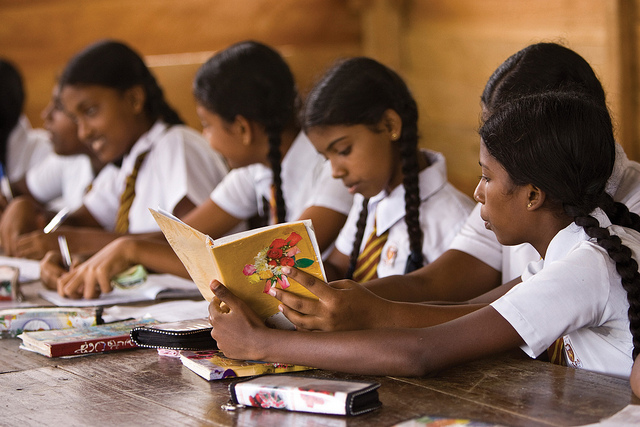
One of the best ways to reduce or eliminate child marriages is through education. Delaying marriage for girls or preventing underage marriages increases education attainment for girls. They are more likely to stay in school and further enhance their education. One research paper that investigated schooling in Bangladesh revealed that postponing marriage by 1 year for girls between the ages of 11 and 16 increased adult literacy by 5.6% and schooling by 0.22 per year. A minimum age requirement for marriage also helped increase female schooling by 9%. Not only does education increase a girl’s understanding of matters such as health, life, and family planning, but it also helps create a better foundation for a better life.
However, in traditional communities where education for girls is deemed unimportant, postponement of marriage for the sake of education does nothing much for girls. They are still barred from working, and education comes to a standstill. This mind-set that girls are meant to be brides, and that is their utmost obligation in life needs to change first.
In instances where girls show a lack of interest in education, parents prefer to get them married than seeing them idle. Other issues that may also contribute to early marriage from the standpoint of education are lack of sanitation for menstruating girls in schools, schools located in far places, poor education quality and intervening religious and customary obligations.
Poverty
Education empowerment is great, but to stay in school, poverty issues need to be resolved. Parents in low-income households choose to give their daughters in marriage in hope of alleviating their financial burdens, and secondly to ensure the daughter’s safety from sexual predators and other forms of violence. Girls in poverty-stricken households are most likely to marry early and be in the same socio-economic background throughout their life.
Unfortunately, education and poverty are interlinked. Girls who want to study are unable to continue to study due to financial burdens. These same burdens limit a child’s education: globally less than two-third of girls in low-income households have completed primary education while 1 in 3 girls have completed lower secondary education. The difference between primary and secondary education is the utilization of information as adults or as working women. Girls with secondary education are likely to make more money than those with only primary education. Their standard of living and working opportunities are much higher as well. It is likely that without education, it becomes increasingly hard to get out of poverty.
Health
18 years is the age when children become adults. They’ve had 18 years to learn, evolve, and develop into an adult – physically, biologically, emotionally, and mentally. When girls marry below the age of 18, growth in every capacity is hindered or even limited. If girls under the age of 18 have babies while they are still developing, they are highly at risk of endangering themselves and their babies.
Globally, the leading cause of death in girls aged 15 to 19 is complications in pregnancy and childbirth. There is a 50% chance for the baby to be stillborn or to die within the first few weeks of life if the mother is under the age of 20. They are also 5 times more likely to die in childbirth especially if the girl is under the age of 15. There is a chance that maternal mortality is higher in young girls indirectly stemming from poor economic backgrounds, inability to afford health services, or because they are living in areas with less or no medical access. The analysis also states that this differs from country to country and via age groups.
In forceful child marriages where parents give their girls in marriage because of religious or customary laws, girls really have no say. But what happens when a girl is sexually exploited and then becomes pregnant? Teen pregnancy then becomes the leading cause for a girl’s marriage at young ages often done to mitigate the shame and embarrassment of out of wedlock births. We should not forget that some child marriages happen purely based on the child’s decision. Girls have eloped at the young ages of 15 and 16 and got married without understanding the seriousness of their decision.
Child marriages also have a huge impact on population growth. A girl who marries at 13 is 26% likely to have more children than one marrying at 18 years or older. As most girls in child marriages marry much older men, young girls have no say in sexual reproduction and are told to do as their husband says. They are likely to not utilize or understand contraception methods due to no or limited education as a result of child marriage in some instances. Ending child marriages can result in an 11% national decline in total fertility.
For adolescents (boys and girls) between the age of 10 and 19, the second leading cause of death is AIDS. Marrying before the age of 18 can increase the risk of HIV infection. Girls children who are married off to older men are more likely to be exposed to sexual diseases and less likely to use contraception thanks to the lack of education once again.
Violence
- Out of 1.3 million adolescent deaths each year (2012 statistics), girls accounts to 45% of them. 10% of girls die from violence.
- Girls who marry before the age of 18 are more likely to experience violence from their partners
Did you know that every 10 minutes, a girl dies as a result of violence? A higher risk of partner violence in child marriages could be down to communication21 issues; Young girls have no way to voice out their likes, dislikes or desires. Their life is not their own. With limited education and understanding of life in general, it might be tough to speak on issues they are facing. Gender inequality is the most likely issue for violence against girls. They have a lower status in society and boys and men are taught to hold power over girls and women as a gift bestowed upon them for the higher status they hold in society leading to more violence. Even actions and practices that go against human rights such as sexual abuse and violence, female genital mutilation or circumcision is accepted in these gender biased societies because women do not have a voice to condone such actions and practices, and neither do they have any inkling or understanding that they are subjected to abuse and violence. It’s worse if girls believe that intimate partner violence for e.g. hitting the wife for not doing something properly is sometimes justifiable27 – more than half of the girls aged 15 to 19 in 39 countries believe so. The difference here could be education after all. Educated girls are less likely to justify intimate partner violence than less educated girls.
Violence is not exclusive to child marriages, but adolescents also experience them at the hands of their parents or caregivers, the most commonly reported perpetrators in 33 countries followed by intimate partners for girls aged 15 and 19. Nearly 2 out of 3 girls aged 10 to 14 are subjected to punishments on a regular basis. The violence referred to here also includes sexual violence. Did you that 1 in 10 (around 120 million) girls have experienced sexual violence such as forced sexual intercourse? Across all countries, sexual violence is most commonly committed by an intimate partners.
We must understand that violence against girls and women is acts of violence committed by boys and men. We put so much emphasis on phrases like ‘violence against girls and women’ without understanding that the root cause of this issue is how boys are brought up in families and society. Boys are not taught to respect girls and women. From a young age, gender inequality has been drilled into their heads: the whispers of men are better than women, and they as the protectors of the world and women must instill good behaviors in them. If there is a necessity, then through the use of violence.
Policy reforms
Everyone talks about policy reforms with facts and figures, and that’s great, but we also forget that these reforms are for humans – for you and me. Changing reforms is not only about how you present your information, but it’s also about understanding human behavior and using that knowledge to bring about change. Why don’t we have psychologists in policy-making positions? Policies are personal and emotional, and we have to understand the consequences of not listening to the very people who are affected. In fact, we are dealing with lives – lives that are subjected to abuse and depression.
We need to have more ground-level discussions where affected girls speak up on what’s happening to them. We need to create safe spaces for our girls to be able to tell their parents and communities on why girls are not meant to be only housewives, why child marriages are unhealthy and unsafe, and what’s really on their minds. We are a community that believes in bottling our feelings and thoughts. Communicating via social media is one thing, but using your voice to communicate personal issues is hard. If keyboard warriors were given the choice to speak up publicly, face-to-face, most of them will refuse. It’s imperative to have open dialogues to understand how issues affect people before we talk for or against a policy.
The truth
From the above research and learnings, we understood that child marriage is a horrendous violation against human and child rights. A child deserves to be a child, to go through the motions of childhood, and learn what is required for her/him to become a good adult and a citizen of the world. That is their right. The best way to reduce or eliminate girl child issues is through education which can improve future earnings and standards of living for women, reduce child marriages and early childbearing drastically, lower fertility and population growth, improve health, nutrition, well-being, decision-making skills, and be able to display altruistic behaviors in young girls. ‘Education is the most powerful weapon which you can use to change the world”, a moving and unforgettable statement by Nelson Mandela.